
January 27, 2026
February 6, 2026
What Payment Terms Should I Negotiate with Large Buyers?

Most enterprise buyers ask for Net 60 payment terms because they can, and most suppliers agree because they think they have to. However, procurement teams are not necessarily trying to squeeze suppliers; they are optimizing for predictable cash management and risk reduction.
Once you understand the psychology of enterprise procurement, you can structure deals that protect your cash flow while providing the predictability buyers need.
The Hidden Cost of Standard Payment Terms
Net 30 appears on roughly 60% of B2B invoices, yet only half are paid on time. When enterprise buyers push for Net 60, the situation often worsens. The disconnect is rarely about a lack of funds. Large buyers favor extended terms because their approval workflows and budget cycles run on fixed monthly or quarterly schedules.
When a supplier agrees to standard Net 60 without additional structure, they are essentially providing a free loan while absorbing all the collection risk. To fix this, you must shift the conversation from "when will you pay" to "how do we manage project risk together."
The Procurement Bypass Framework
This framework moves payment terms away from a separate financial negotiation and ties them directly to project delivery. It consists of three parts: milestone-based payments, liquidity premiums, and scope protection.
Milestone-Based Payment Structure
Instead of one large invoice at the end, break the project into three or four clear phases. For a $50,000 project, a typical structure might look like this:
- 30% at Kickoff: Initial deposit to begin work.
- 25% at First Review: Payment triggered by a major deliverable.
- 25% at Implementation: Payment upon completion of the core build.
- 20% at Final Acceptance: The remaining balance when the project concludes.
This works because it aligns with procurement's view of risk. They aren't worried about the cost; they are worried about paying for work that is late or low quality. Milestone payments provide them with natural "checkpoints" to verify value before releasing more funds.
Liquidity Premium Pricing
Instead of offering early payment discounts, build different price tiers based on payment terms. Your base price should assume immediate payment or Net 15. Extended terms then incur a "Liquidity Premium."
- Base Price: Net 0 or Net 15.
- Net 30: Add 3% to 5%.
- Net 60: Add 8% to 12%.
This is not a late fee or a penalty; it is transparent pricing for the financing you are providing. Most enterprise buyers will choose faster terms when the cost of waiting is made explicit. If they still choose Net 60, they are making an informed business choice to pay for the cash flow flexibility.
Scope Protection Clauses
Extended payment terms should always include automatic scope adjustments. If a client is slow to pay, they often simultaneously request extra work. A scope protection clause stops this pattern.
Include language stating that the project scope remains fixed until the current milestone payment is complete. Any additional requests made while a payment is pending should be quoted separately with immediate payment terms. This protects you from the "double hit" of late payments combined with expanded work requirements.
The Framework in Practice
Consider a digital agency negotiating a $75,000 deal. The client originally requested Net 60 terms. By applying the framework, the agency restructured the deal into four milestones with transparent pricing tiers.
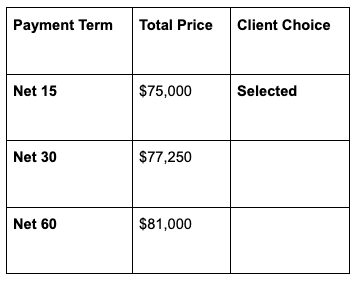
The client’s finance team chose Net 15 across all milestones. The transparent pricing made them realize they were better off managing their own cash than paying a premium. Instead of the agency waiting 17 weeks to collect the full balance, they received steady cash flow throughout the 12-week project.
Strategy for Your Next Enterprise Deal
To move away from the "standard" trap, implement these three steps in your next negotiation:
- Align with Workflows: Use a milestone structure that mirrors the client's internal approval checkpoints.
- Price the Financing: Make the cost of extended terms transparent from the first quote.
- Protect the Scope: Explicitly link the continuation of work to the timely receipt of milestone payments.
The goal is not to be difficult about money, but to create an agreement that acknowledges the real cost of capital. When you structure payments around project success and transparent pricing, you protect your business and provide the enterprise buyer with the professional, predictable process they require.