
October 9, 2025
6 min read
May 8, 2026

A product's success is a combination of the right market fit and careful testing during product development. One of the first steps in this journey is idea validation. It might seem minor, but validating an idea before jumping head-first into development can and will save you lots of trouble down the road.
The three most popular approaches to testing the assumptions behind your idea are building a proof of concept, a prototype, and a minimum viable product. Each comes with its own advantages and serves best in a particular case. If you're wondering how they work and how they differ, here's a rundown that will help you find the perfect fit.
PoC is a feasibility study in the project discovery phase before the development of a full-fledged product. It is a small, internal, stand-alone project aimed at validating that a core feature or tech assumption can in fact be implemented and will function as envisioned.
Proof of concept helps validate that the technical capabilities, tools, and resources you need to make your idea work are viable. Since it is used for internal purposes, a PoC largely neglects UI, security, and development best practices. The code is rarely reused at later development stages, so it is often hard-coded and has mock APIs and basic UI controls.
Developing a PoC is an excellent way to perform a try-run of your concept at a low cost and in a limited timeframe. A proof of concept can also help you:
Once you finish the PoC stage, you will better understand your project's constraints. If your concept proves viable, you can move on to the prototyping or MVP development phase.
Prototypes are early product samples meant to demonstrate your business concept before implementing it. It simplifies your product idea into an easily digestible format intended to reveal its value.
Prototyping makes it easier to fill any gaps in your concept and your understanding by discovering all needs and specifications. The choice of form depends on your product and the features you want to test. User feedback gathered during prototyping provides insights into needs and expectations, ensuring the final design is effective. It is significantly cheaper to fix a problem in a model than in a finished product, leading to cost and time savings.
One of the main reasons companies create prototypes is to collect early feedback from real users and stakeholders before starting large-scale development. Prototyping is also widely used for:
A minimum viable product is a releasable version of your product that contains enough core features to attract early adopters. Early adopters' interaction with an MVP lets you get to know your target audience better and gauge their acceptance of your product.
Small in scale, fast, and affordable. That is how you often hear an MVP described. A good MVP helps you validate the market need without building a comprehensive product.
Starting from an MVP tests the waters first to reduce the risk of failure. You save time and money and find out whether to proceed, adapt, or go back to the drawing board. Other reasons include building customer relationships and securing venture capital.
A proof of concept, prototypes, and MVP are different stages in the product development process. A PoC and a prototype are used at the pre-product stage and require minimal to medium investment. With MVP development, you enter a product stage with core technologies to see how the market receives your idea.
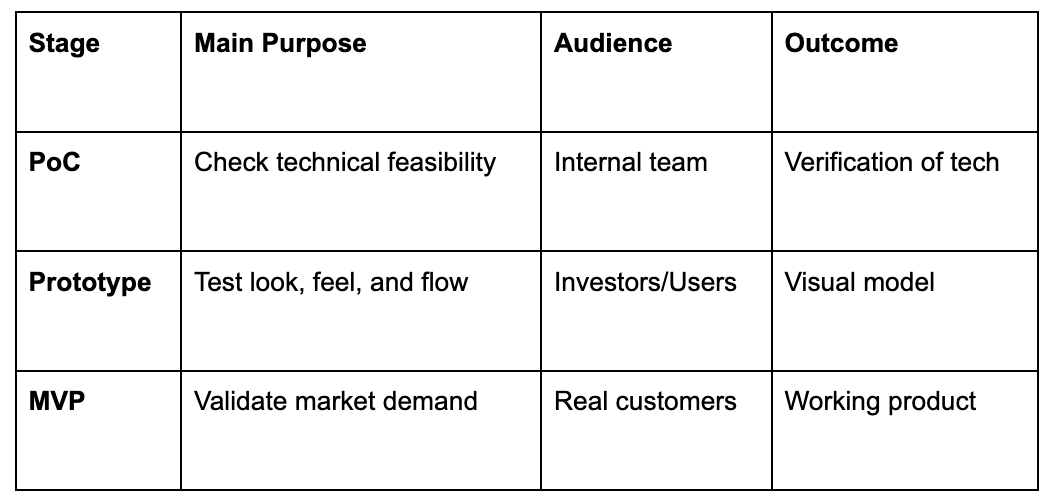
Your choice should depend on your product stage, purpose, and plans.
All the listed options serve the same overall aim, which is to validate your idea. Choosing the right approach at the outset can help you increase the likelihood that your business will succeed and that you will use your resources wisely.
In a nutshell:
What’s the actual difference between PoC, prototype, and MVP?
A PoC answers a specific technical question. A prototype shifts the focus to the user experience. An MVP is the first functional version released to the market.
How long does each stage usually take?
A PoC usually takes from a few days to a couple of weeks. A prototype often spans several weeks. An MVP typically takes a few months to develop and deploy.
Can I skip the PoC and go straight to Prototype?
Yes, if your technology is standard and your main risk is user adoption rather than technical feasibility.