February 6, 2026
February 6, 2026
How Do I Prioritize Roadmap Items Across Founders, Customers, and Sales?

Founders often treat product management as a series of negotiations. They sit at the center of a tug-of-war between the vision in their head, the demands of the sales team trying to close a "must-have" enterprise deal, and the vocal complaints of existing customers. This friction is not a sign of a bad product. It is a sign of an absent operating system.
When Product Roadmap Prioritization becomes a reactive exercise, the company loses its competitive edge. Most founders attempt to solve this by working harder or hiring more developers. They believe the bottleneck is capacity. It is actually a failure of logic. Without a systemic way to weigh competing interests, the loudest voice wins. Usually, that voice belongs to the biggest potential check or the most frustrated user. This guide provides the framework to transition from reactive firefighting to a disciplined, revenue-aligned product strategy.
What Most Founders Get Wrong
Tactical advice fails when the foundation is cracked. Founders frequently fall into three traps that sabotage their long-term growth.
1. The Fallacy of the "Big Deal"
Sales teams often present a single feature request as the only barrier to a massive contract. Founders succumb to this pressure because the short-term revenue is intoxicating. However, building for one customer is consulting, not product development. If a feature does not serve the broader market, it becomes "technical debt" that the rest of your engineering team must maintain forever.
2. Confusing Feedback with Direction
Customers are excellent at identifying pain points but terrible at designing solutions. When a founder builds exactly what a customer asks for, they often end up with a cluttered UI and a disjointed user experience. Professional product management requires translating customer complaints into systemic improvements that benefit the entire user base.
3. The Vision Vacuum
Some founders ignore all external inputs and build solely based on intuition. While vision is necessary, it must be validated by market reality. A roadmap built in a vacuum leads to "beautiful" products that nobody buys. True prioritization requires a synthesis of internal conviction and external evidence.
The Underlying System: Mechanics and Constraints
Effective Product Roadmap Prioritization operates on a simple mathematical reality. Resources (time, talent, capital) are finite. Demands are infinite. To manage this, a founder must establish a "Product Operating System" that filters every request through three lenses: Viability, Desirability, and Feasibility.
Pro Tip: The most successful startups treat "No" as their default position. Every new feature added to a roadmap increases the complexity of the codebase and the cognitive load on the user. A feature that does not directly contribute to a 10x improvement in a core metric is a distraction.
The Inputs
- Strategic Vision: Does this move us toward our 3-year North Star?
- Sales Enablement: Does this unblock a specific market segment (not just one company)?
- Customer Success: Does this reduce churn or increase expansion?
- Technical Health: Does this reduce debt or improve scalability?
Step-by-Step Implementation Framework
Step 1: Foundational Clarity
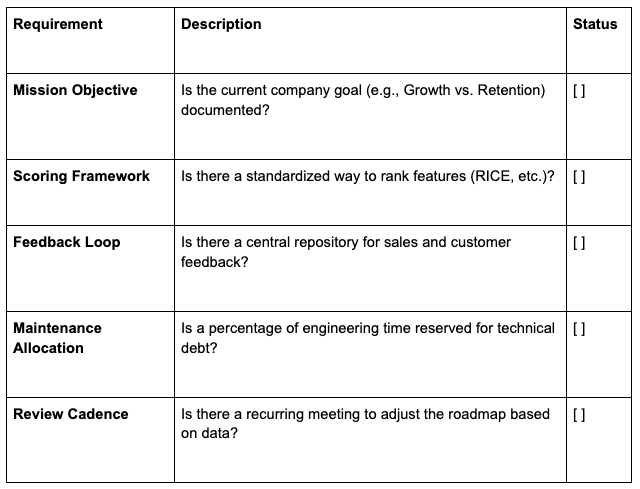
Before looking at a backlog, define the current "Mission Objective." Are you in a season of aggressive customer acquisition, or are you focused on retention? If the objective is acquisition, sales-led features take precedence. If the objective is retention, customer-led stability takes the lead. Without this clarity, prioritization is impossible because there is no yardstick for success.
Step 2: Decision Rules and Constraints
Establish a scoring model that everyone agrees on. Use a modified RICE (Reach, Impact, Confidence, Effort) score or a simple MoSCoW (Must-have, Should-have, Could-have, Won't-have) framework. The key is consistency. When a salesperson brings an "urgent" request, the first question should be: "How does this score against our existing backlog?"
Step 3: Execution Loops
Run development in tight cycles. Avoid six-month roadmaps that are carved in stone. Instead, commit to a "Rolling 6-Week Plan." This allows the team to pivot based on real-time data while providing enough runway for engineers to do deep work.
Step 4: Measurement and Feedback
Once a feature is shipped, the work is not done. You must measure the "Feature Adoption Rate." If the sales-requested feature was built but the deal didn't close, or if the customer-requested feature is only used by 1% of the base, the prioritization system needs recalibration.
Common Mistakes That Compound
Mistake 1: The "Squeaky Wheel" Bias
Prioritizing based on the most recent or loudest feedback.
Correction: Use a weighted scoring system that accounts for the "Lifetime Value" of the segment requesting the change.
Mistake 2: Ignoring Maintenance
Allocating 100% of resources to new features.
Correction: Mandate a "Maintenance Tax." Dedicate 20% of every cycle to bug fixes and infrastructure. This prevents the "velocity cliff" where development slows to a crawl due to accumulated debt.
Mistake 3: Lack of Transparency
Keeping the roadmap a secret from the sales and success teams.
Correction: Maintain a public (internal) roadmap that explains the "Why" behind the "What." When people understand the constraints, they are less likely to fight the decisions.
The Operating System Connection
Product Roadmap Prioritization is not just a product task. It is a leadership task. It connects the high-level strategy to the daily output of the engineering team. When this system is functioning correctly, it provides the founder with the highest form of leverage: the ability to say "Yes" to the right things and "No" to everything else without causing organizational friction.
System Readiness Checklist
Conclusion
Mastering SaaS Product Strategy requires moving beyond the "Feature Factory" mindset. It requires the discipline to view your product as a vehicle for a specific business outcome, rather than a collection of requests. By implementing a systematic approach to Feature Backlog Management, you eliminate the emotional toll of stakeholder conflict and replace it with data-driven confidence.
Would you like to build a business that runs on logic instead of chaos?
Subscribe to THE FOUNDER’S OPERATING SYSTEM. This is the definitive playbook for running a high-growth business intentionally. Get actionable insights on strategy, operations, and leadership delivered directly to your inbox.