
October 9, 2025
9 mins read
January 27, 2026

Most SaaS pricing failures do not come from bad products. They come from billing models that either undercharge power users or scare away teams before they reach value.
Seat-based pricing alone caps revenue just as customers scale. Usage-based pricing alone introduces unpredictability that finance teams hate and buyers resist. Founders who treat this as a simple pricing toggle often discover too late that churn, discounting, and sales friction were self-inflicted.
This guide shows how to implement seat-based and usage-based billing together in a way that aligns revenue with value, keeps sales cycles clean, and scales without constant repricing. Readers will walk away with a working mental model, real case studies, and a quarterly action plan they can actually execute.
A hybrid billing model has three layers. Confusion happens when these layers are blended instead of intentionally separated.
1. Seats define access and collaboration
Seats answer one question. How many people inside the customer account can log in and work.
They work best when:
2. Usage defines value consumption
Usage answers a different question. How much value is the customer actually extracting.
Common usage metrics include:
3. The invoice is the reconciliation layer
The invoice is where predictability and fairness must coexist.
A clean hybrid invoice usually looks like:
Deep Dive: The Expansion Efficiency Ratio
Expansion Efficiency Ratio = Net Usage Revenue Growth ÷ Net Seat Growth
When this ratio is below 1.0, customers add users faster than they consume value. When it is above 1.0, power users drive expansion without headcount growth. Healthy hybrid models trend above 1.2 within mature cohorts.
Hybrid pricing is not just a pricing decision. It affects sales motion, onboarding, and product design.
Sales complexity increases before it decreases
Early on, sales teams need better enablement. They must explain both access and consumption clearly. Over time, deal sizes stabilize and discounting drops because pricing aligns with reality.
Product teams become pricing stakeholders
Every feature that affects usage now affects revenue. This forces better prioritization and cleaner instrumentation.
Finance gains forecasting leverage
While usage adds variability, seat floors anchor revenue. This makes forecasting easier than pure usage models when implemented correctly.
Company profile
Old model
Problem
Power users consumed 10x more resources than average customers but paid the same. Infrastructure costs rose faster than revenue.
Hybrid implementation
Results after 9 months
Key insight: usage was framed as growth enablement, not penalty.
Company profile
What went wrong
Customers experienced surprise invoices. Support tickets spiked. Social proof turned negative.
The fix
Outcome
Focus: clarity before complexity.
Deliverable: a single pricing worksheet that ties seats, usage, and revenue together.
Focus: controlled exposure.
Deliverable: validated pricing guardrails with live data.
Focus: removing human error.
Deliverable: a billing system that scales without manual intervention.
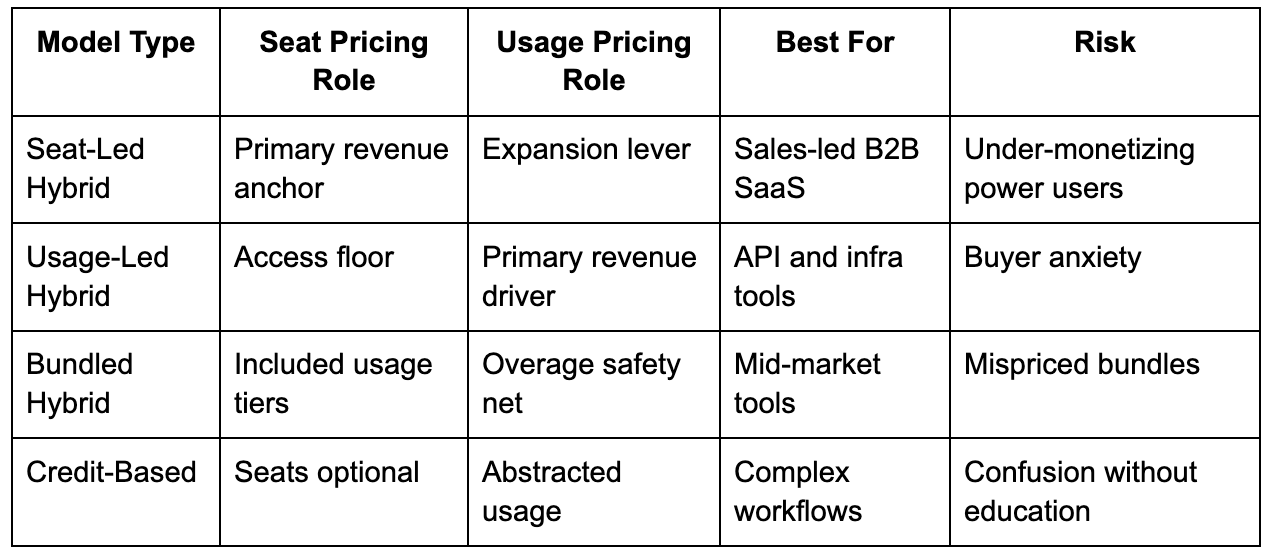
Myth 1: Hybrid pricing always scares buyers
Expert reality: poor communication scares buyers. Clear thresholds build trust.
Myth 2: Usage pricing kills predictability
Expert reality: seat floors stabilize revenue while usage drives expansion.
Myth 3: This only works for technical products
Expert reality: non-technical teams understand usage when it maps to outcomes they care about.
Hybrid pricing works when access and value are priced separately but explained together.
Non-negotiable takeaways
Next 72 hours
Founders who delay this decision often revisit it under pressure. Those who implement it early build pricing that grows with their customers instead of fighting them.
For a step-by-step breakdown, subscribe to our newsletter and get the free Startup Validation Checklist used by scaling SaaS teams worldwide.