
October 19, 2025
April 20, 2026
Do You Have an Activation Checklist for Onboarding New Users?

Most early-stage founders treat low activation rates as a UX problem. They redesign the welcome screen. They add a product tour. They shorten the setup wizard and write friendlier microcopy. Churn stays flat. Sometimes it gets worse.
The reason is straightforward: they are solving the wrong layer of the problem.
When new users leave before experiencing a product's core value, the failure is almost never the interface. The failure is the absence of a working activation system. No one on the team has formally defined what "activated" actually means. There is no behavioral trigger wired to that definition. There is no feedback loop measuring whether the onboarding sequence is accelerating users toward that moment or quietly redirecting them away from it.
This is not a design failure. This is an operating system failure.
User onboarding is one of the highest-leverage systems in a SaaS business. According to research from the product analytics community, users who reach activation within the first session are between 4 and 6 times more likely to be retained at 30 days compared to users who do not. Yet the majority of seed-stage teams manage onboarding the way they managed their first product demo: with instinct, iteration, and no formal success criteria.
This guide does not offer another product tour template. It offers the system: a precise, repeatable activation framework built around behavioral milestones, decision logic, and measurement cadences. Founders who apply it consistently see measurable improvements in 30-day retention, time-to-value, and conversion from trial to paid.
What Most Founders Get Wrong About Activation
Before the framework, three misconceptions must be addressed, because they are the reason most onboarding sequences fail to move the retention needle.
Misconception 1: Activation is the same as account creation.
Account creation is a mechanical step. A user clicked a link, typed an email address, and verified their inbox. That is a data entry event. Activation is a value delivery event. It is the first time the product solves the specific problem the user showed up to solve. Conflating the two means the team is measuring the wrong milestone and optimizing toward a metric that has no predictive power over retention.
Misconception 2: The activation checklist is built around product features, not user outcomes.
Feature-based checklists ask users to complete tasks tied to the product's architecture: "Connect your calendar," "Import your contacts," "Set up your first integration." Outcome-based activation asks a different question: what is the first moment the user receives the value they came for?
Misconception 3: Onboarding is a one-time event, not a continuous system.
Many teams ship an onboarding flow once and treat it as infrastructure. High-retention teams treat onboarding as a living system with a defined review cadence, behavioral segmentation, and A/B testing protocols. The checklist is not a one-time deliverable. It is the current version of an ongoing experiment.
How Activation Actually Works
Activation is a behavioral milestone, and like any milestone, it requires a precise definition, a measurable proxy, and a structured path for getting users there.
The architecture of an activation system has four components:
1. The Activation Moment (The "Aha" Moment)
The activation moment is the specific behavioral event that predicts long-term retention. It is product-specific and must be discovered empirically. For a file-sharing tool, it might be "user uploads a file and shares it with one external collaborator within 48 hours."
To find it, teams must run a cohort analysis comparing users who were retained at 60 days against those who churned within 30 days, then identify which early behavioral events are predictive of retention. This is not guesswork. It is data archaeology.
2. The Time-to-Value Constraint
Activation without a time constraint is not a useful metric. A user who reaches the activation moment in 4 hours is more valuable than one who reaches it in 4 days.
Research from SaaS onboarding specialists consistently shows that time-to-value (the time between account creation and activation) is one of the strongest leading indicators of 30-day retention. A practical starting benchmark for B2B SaaS is 24 to 48 hours for self-serve products and 5 to 7 days for implementation-heavy platforms.
3. The Activation Rate Baseline
Activation rate is the percentage of new users who reach the activation moment within the defined time window.
Activation\ Rate = \frac{Users\ Reaching\ Aha\ Moment}{Total\ Signups\ in\ Cohort} \times 100
A common baseline for well-run B2B SaaS products is 30% to 50% activation within 48 hours. Early-stage products with minimal onboarding infrastructure often sit below 20%.
4. The Onboarding Sequence as a Conversion Funnel
The onboarding sequence is not a tour of the product. It is a conversion funnel with one job: move users from account creation to activation as efficiently as possible.
Pro Tip: The single most effective onboarding intervention is a "why did you sign up?" question asked immediately after account creation. The answer segments users by their primary use case, allowing the onboarding sequence to route them toward the relevant activation moment.
Step-by-Step Activation Implementation Framework
Stage 1: Foundational Clarity
Before building anything, the team must define four things in writing:
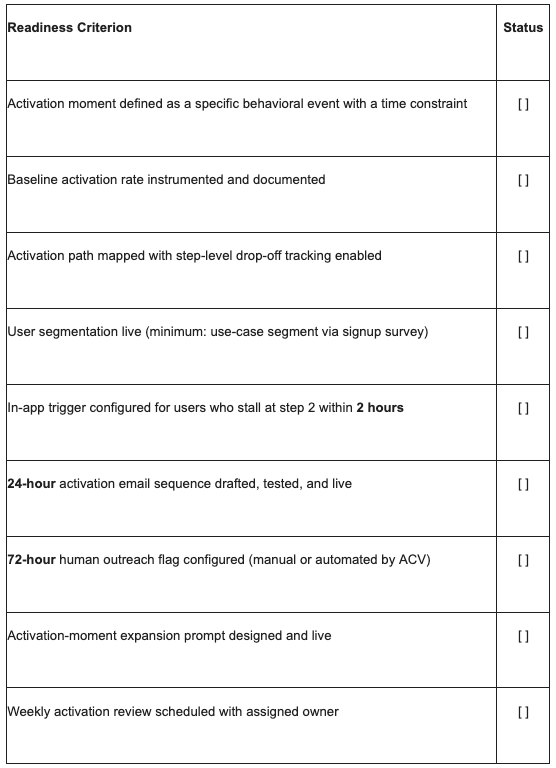
- Define the activation moment. Write it as a specific behavioral event with a time constraint. Example: "User creates one project, adds one task, and assigns it to a team member within 72 hours of account creation."
- Define the activation rate baseline. Instrument the relevant events in your analytics tool.
- Map the activation path. List every behavioral step between account creation and the activation moment. The activation path for a typical B2B product has between 4 and 8 steps.
- Segment users by intent. Use the signup survey to segment new users by their primary use case.
Stage 2: Decision Rules
The activation system needs decision logic to route users and trigger the right interventions.
- Rule 1: If a user has not completed step 2 of the activation path within 2 hours, trigger a contextual in-app prompt asking "Are you stuck, or did something come up?"
- Rule 2: If a user has not reached activation within 24 hours, trigger an email sequence. Subject line example: "You are one step from [specific outcome]."
- Rule 3: If a user has not reached activation within 72 hours, flag them for human outreach (automated for low ACV, personal for ACV > $5,000/year).
- Rule 4: If a user reaches activation, trigger an expansion prompt. This is the highest-intent moment; surface the next layer of value immediately.
Stage 3: Execution Loops
- Weekly activation review: Review the activation funnel report. Identify the single highest drop-off point and form one hypothesis for an A/B test.
- Biweekly onboarding audit: Create a new test account and complete the onboarding flow from scratch to catch regressions.
- Monthly cohort analysis: Compare the activation rate and 30-day retention rate of the current cohort against previous ones to ensure the system is improving retention.
Stage 4: Measurement
Track these metrics on a weekly basis:
- Activation rate: Target above 35% for self-serve B2B.
- Time-to-value (median): Target below 48 hours.
- Step-level drop-off rate: Any step above 40% is a priority for intervention.
- Activation-to-retention correlation: Ensure activated users are staying longer than non-activated ones.
Common Mistakes That Compound Over Time
Error 1: Building the checklist for the product team, not the user.
Avoid checklists that ask users to "Explore the dashboard" or "Read the guide." These reflect product architecture, not user outcomes. Every item must either be a required step to reach the activation moment or be predictive of retention.
Error 2: Ignoring the segment-specific activation benchmark.
Applying a single benchmark across all segments is a mistake. A user from a search ad vs. a user from a 500-person company have different constraints. One segment might activate at 60% while another sits at 10%; they need different interventions.
Error 3: Conflating product engagement with activation.
A user who logs in three times but never completes the "Aha" moment is curious, not activated. Curiosity does not predict retention. Don't use login frequency as a proxy for value delivery.
System Readiness Checklist
Activation Is the Product's First Promise
A product makes an implicit promise at signup: "We will help you accomplish X." The activation moment is the first time the product delivers on that promise. Everything in the onboarding system should be organized around accelerating users to that moment.
The activation checklist is not a UX artifact. It is the operating mechanism that determines whether new users stay long enough to become customers and champions. Founders who treat activation as a system, rather than a screen, consistently outperform those who treat it as a design challenge.