
The modern founder often mistakes movement for progress. Nowhere is this more evident than in the "specification vacuum." This is a state where products are built on a foundation of vague Slack threads, hurried voice notes, and aspirational bullet points. Data suggests that the average Series B startup loses roughly 30% of its engineering capacity to rework. This is the invisible tax of the "move fast and break things" era.
It is not just a loss of time. It is a compounding loss of capital. When a founder fails to articulate a product specification with mathematical precision, they are not being agile. They are being expensive. The friction arises when the "vision" in the founder's head meets the literal interpretation of a compiler. This gap is where technical debt is born. Artificial intelligence provides a mechanism to bridge this gap. It acts as a cognitive lever. By offloading the initial structural synthesis to a large language model, a leader transforms from a manual writer into a systems architect.
What Most Founders Get Wrong
Tactical advice regarding AI usually focuses on "saving time." This is a shallow metric. If you save two hours writing a bad spec, you have simply accelerated the production of waste. Founders typically fall into three traps:
- The "Dictation" Fallacy: Many believe AI is a transcription service. They dump a stream of consciousness into a prompt and expect a polished PRD. This ignores the "Garbage In, Garbage Out" (GIGO) principle. AI requires structured constraints to produce structured logic.
- Treating Specs as Feature Lists: A product spec is not a shopping list. It is a logic-gate system. Most founders focus on the "what" while ignoring the "if-then" sequences. Without defining the edge cases, the AI will hallucinate a happy path that fails the moment a user deviates from the expected behavior.
- The Autopilot Error: There is a misconception that AI replaces the need for product intuition. In reality, AI amplifies the need for editorial rigor. A founder must move from "Writer" to "Chief Editor," stress-testing the AI's output against market reality and technical constraints.
The Underlying System: Structural Alignment
The primary system at play here is Structural Alignment. To use AI effectively for a first draft, one must understand the second-order effects of input quality. A weak prompt yields a generic spec. A generic spec leads to "feature creep" because the boundaries of the product were never defined.
The system relies on the variable of Constraint Density. In a standard spec, a founder might say they want a "fast checkout." In a high-velocity AI-driven system, the leader defines the constraint: "The checkout must process a transaction in under 200 milliseconds to avoid a 5% drop in conversion observed in previous quarters."
When you feed these specific constraints into an AI, the model performs a logic audit. It identifies where your desired outcomes conflict with your technical limitations.
Pro Tip: Use AI to generate a "Negative Spec." Ask the model to define exactly what the feature will not do. This prevents scope creep more effectively than any positive requirement ever could.
Step-by-Step Implementation Framework
Step 1: Foundational Clarity (The Context Layer)
Before prompting, you must define the "World State." This includes your existing tech stack, user personas, and core KPIs. AI cannot build in a vacuum. You must provide the "Environmental Constraints."
- Action: Create a "Product Context File" that includes your API documentation summaries and UI component library.
Step 2: Decision Rules & Constraints
Define the logic gates. Instead of describing a feature, describe the rules that govern it. Use a "Given-When-Then" format.
- Example: "Given a user has an expired subscription, when they attempt to access the dashboard, then they should be redirected to the billing page with a specific discount code active."
- AI Prompting: Instruct the AI to identify three potential failure points in this logic.
Step 3: Execution Loops (The Draft Zero Protocol)
No human should write a spec from a blank page. The AI generates "Draft Zero."
- Process: Provide the AI with the core objective. Ask for three versions:
- The "Lean" version (minimum code).
- The "Scalable" version (high performance).
- The "Experimental" version (high UX innovation).
Step 4: Measurement & Feedback (The Logic Audit)
Hand the Draft Zero to your lead engineer. Their job is not to build it yet. Their job is to give it a "Feasibility Score" from 1 to 10.
- Feedback Loop: Feed the engineer's concerns back into the AI to refine the spec. This eliminates the back-and-forth Slack cycles that kill momentum.
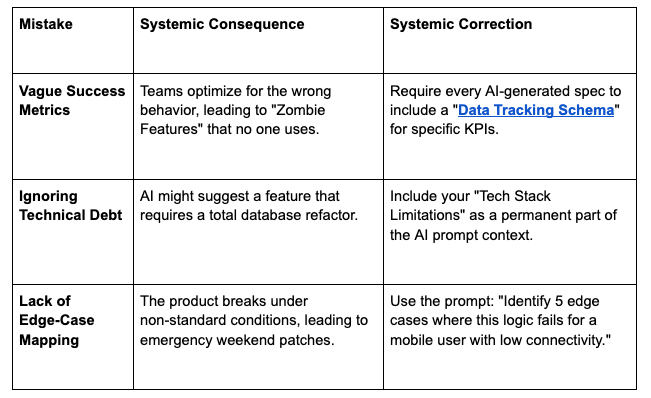
Common Mistakes That Compound
The Operating System Connection
A product spec is not a standalone document. It is a component of your Company Operating System. It connects directly to:
- Resource Allocation: A clear spec allows for accurate "Story Pointing" and sprint planning.
- Capital Efficiency: By reducing engineering rework, you extend your runway.
- Cultural Alignment: Clear documentation reduces the "Anxiety of Ambiguity" within your engineering team.
When you systematize spec writing through AI, you are not just "writing faster." You are creating a repeatable asset that can be audited, scaled, and improved. This is the difference between a project-based company and a systems-based company.
System Readiness Checklist
.png)
The transition from a reactive leader to a systems-driven CEO requires an immediate shift in how you handle information. Stop writing. Start architecting. The era of the "visionary" who cannot document is over. The future belongs to the founder who uses AI to turn vision into a repeatable, scalable, and mathematically sound system.
Ready to upgrade your leadership stack?
Subscribe to THE FOUNDER’S OPERATING SYSTEM for weekly deep dives into systemic scaling and AI-driven efficiency.